Two heads of tax at large Australian companies told me recently that their teams aren’t adopting AI as fast as they’d like.
Their teams use AI for spot tasks here and there: reconcile this balance, transform this raw data. What they aren’t doing yet is turning those tasks into repeatable skills the whole team can share, or keeping agent.md files that hold the long-running context on a task.
The usual reading is that tax people are careful with new tools. They are. They sign for every number, so they should be. Pushing has little to do with it. The tax teams I see adopting fastest are the ones whose AI can reach the ledger, and whose hours have somewhere worth going.
Pace is an input
Adoption pace is the first thing a company measures when it buys AI at scale, because it is the easiest thing to measure: who has a seat, who is using it, how much. A count like that tells you the tool was used. It says nothing about whether the numbers were explained, the positions documented, or the team in the room before a decision was made.
A tax function should be measured on its results: the record it keeps, and the time it spends in the business. Measured that way, the question for the two heads of tax changes. Faster at what?
Where the hours go now
A tax team’s hours go where its numbers live: the close, the reconciliations, the tax effect accounting, the tax note, the information request from the ATO, the evidence behind the board pack. Those numbers sit in workbooks, a tax engine, email approvals and shared drives. A general-purpose assistant can summarise a ruling or tidy an email. It can’t see the ledger, so it can’t reach the work that takes the time.
That is why adoption has been slow. AI has had nothing to reach. The pace is a plumbing fact, not a people fact.
The trade every tax function makes
Tax functions have always been resource constrained, and they have managed it in two ways.
The first is materiality. Below a threshold, a position gets a lighter look. Sometimes the threshold is agreed with the ATO, more often it is the team’s own, and either way it is a resource decision. It does not stop the ATO inspecting a number in full when it chooses to.
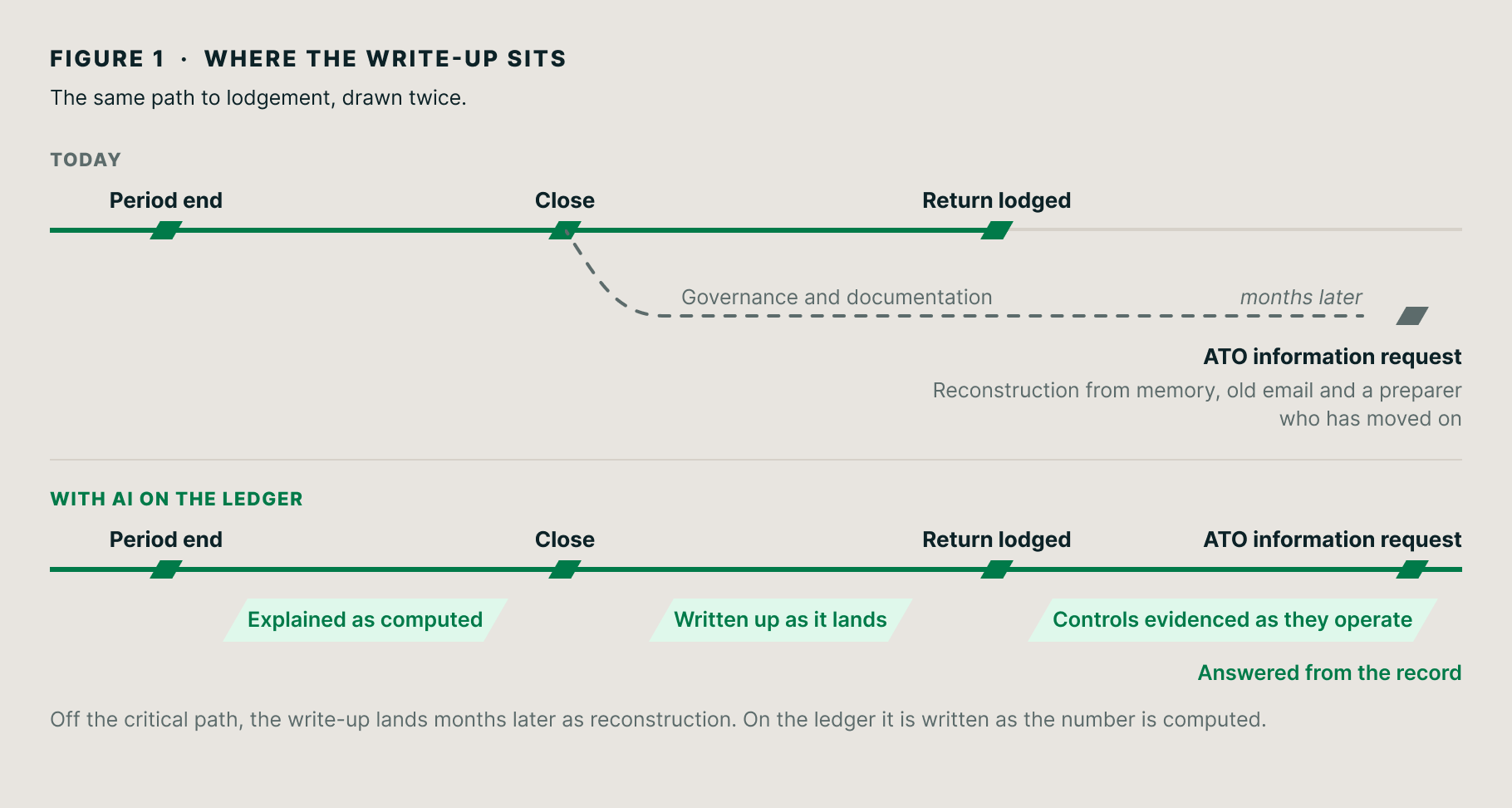
The second is timing. Governance and documentation are not on the critical path to lodging the return, so they come after, when there is time. A resource-constrained function kicks that can down the road and collates the documentation when the ATO’s information request arrives. That is Russian roulette. The request lands on the number nobody wrote up, and the team reconstructs the position from memory, old email and a preparer who has since moved on. The reconstruction costs more than the write-up would have at the time, and it answers the ATO from recollection rather than from the record.
Both trades were rational while documentation cost hours the lodgement needed. Give AI the ledger and the price changes. When the explanation is drafted as the number is computed, the write-up stops competing with lodgement for time, and it moves onto the critical path because it costs nothing to put it there. The can stops being kicked because doing it now became cheaper than doing it later. Materiality goes back to being a judgement about risk rather than a way of rationing hours.
What comes back when AI reaches the ledger
Connect the agent your team already uses to the tax data itself, so it works on the real numbers instead of pasted extracts, and the work changes shape.
Variance explanations arrive drafted. Before the reviewer opens the file, each movement is traced to the account that moved and the adjustment that followed. The reviewer checks it.
Significant transactions are written up as they land. The position, its basis and the evidence go into the return file in the period, so the write-up is already there when the information request comes.
The tax note starts as a first draft from the numbers. Positions attached, basis stated, ready for review.
An information request is answered from the record. The workpaper, the rule, the dated comment, in the order the ATO asked for them, instead of reassembled from memory and email.
An impartial review runs over the whole ledger. The agent reads every adjustment and flags the risks and the adjustments without support, before the reviewer or the ATO finds them.
A new starter works from the team’s method on day one. A skill file holds how the team does a task: the steps, the checks, the thresholds, who signs. The method stops living in one person’s head.
The first time one client’s reviewer ran that review, they couldn’t believe how quickly it found discrepancies in the support for tax adjustments. They updated the workpapers so they were consistent and understandable.
The hours don’t disappear. They move up the chain to the people who sign. Stanford and MIT researchers found that accountants using AI closed the monthly books 7.5 days faster, and that experienced accountants got the most from it because they knew when to step in. The judgement that makes a tax person valuable to the business is the same judgement that makes AI safe to use.
Where the hours should go
Tax protects the most value before a decision is made. The hours that come back belong in the room when a deal is structured, before a capex plan is set, when funding is arranged. They belong in the board paper that explains which business drivers moved the effective tax rate, and why. And they belong in the conversation with the ATO, led from the record instead of rehearsed for a month.
Decide where the hours go before they arrive. If the AI dividend is absorbed as cost-out, the team shrinks and nobody partners. Name the reinvestment up front and report it. For a function that has always been under-resourced, a mandate from the top to use AI is the first one in a long time with money behind it. It also settles the headcount conversation in advance. A head of tax who has already moved the hours into the business has the answer written: keep the team you have, and move its hours to the work the business needs.
Whose AI it is
Whoever runs the AI learns the method. If the agent runs inside a vendor’s application, the capability sits in the application. If an advisory firm runs it, the firm’s capability grows. If the team runs it, the team’s does. A strong tax function uses its advisers for advice and keeps the mechanics of its own compliance in its own hands. That holds for AI as it holds for the platform and the data.
In practice that is three things. The method lives in the team’s skill files, so what one person worked out becomes what the whole team does. The agent acts as a named user, inside the team’s own controls, and stops at judgement. And the ledger it reads belongs to the taxpayer. In TaxTime that runs through the TaxTime MCP, which connects the agent your team already uses to the Tax Ledger.
Measure the results, not the inputs
The ATO adopts AI for its own work only where the core tests of explainability, defensibility and auditability are proven, it told its Large Business Stewardship Group in August, and it is considering what guidance, transparency statements or disclosure expectations may apply to AI use across the tax system. A head of tax can turn those three tests into the results the team is measured on, whether AI did the work or a person did. Adoption pace is an input, and these are the results.
Explained. The share of tax adjustments explained by a dated, attributed comment in the workpaper.
Documented. The share of significant transactions documented in the tax return file before lodgement, with the position taken and its basis in the law.
Governed in real time. The share of the tax governance framework evidenced as each control operates, inside the period, rather than reconstructed for the next Justified Trust review.
In the business. The share of the team’s week spent with the business before decisions are made.
Set the targets up front (the first three belong near 100%) and have the ledger print the scores. A results dashboard the team assembles by hand is one more treadmill task. The agent that drafts the explanations is the agent that can count the gaps, and a report that grades its own completeness and prints the fails can be reviewed. A count of inputs can only be believed. A team measured this way has nothing to retrofit when the ATO’s guidance arrives.
How a leader moves the team
The trades above were made by leaders rationing hours. Moving the team is the same job the other way: give some hours back.
Allocate a protected share of the week to experimenting with AI on the team’s own processes, and keep it protected through the close. Half a day a fortnight is enough to start. What matters is that nobody has to steal it from lodgement.
Then run a competition. Pick the processes that eat the hours: a reconciliation, the tax note draft, the fixed asset register check, the last information request. Each entrant builds the method with the agent on real data, as a named user, stopping at judgement. The reviewers judge, and they judge results: whether the output passes the three tests, how much review time it saves, and whether the method can be written down. The winning method becomes a skill file for the whole team, with the entrant’s name on it.
That is a leaderboard worth having. Rank people on how much they use the tool and they will use the tool. Rank them on explained adjustments and documented positions and the function gets a better record. It also gets a team that wants the tool, because the people who found the method own it.
The conversation with the CFO
The controller asks how much of the team is using AI. The CFO asks whether tax was in the room before we signed.
The heads of tax I spoke with are right to want their teams moving. The move is to give the team’s AI the ledger and judge what comes back on results. A strong and independent tax function owns its platform, its data and its method, and spends the hours it gets back where tax protects the most value: in the business, before the decision.
If the close gave your team a week back, where in the business would you spend it?
Off the Tax Treadmill. On to Impact.